Alan Sims: Exploring the Dao of Movement
Edition Four – Week Four:
Written by: Mercedes Barreto
Introduction
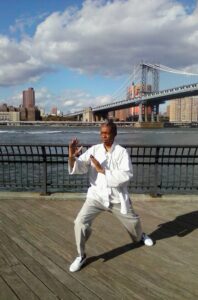
Movement can be many things: discipline, expression, communication, defense, art, and discovery. For martial artist and movement practitioner Alan Sims, movement also represents a journey toward greater freedom, creativity, and understanding.
With experience studying karate, Ving Tsun Kung Fu, and Taijiquan, Sims has developed a distinctive perspective on the possibilities contained within martial arts movement. His writings explore the relationship between Taijiquan, improvisation, dance, sports, self-expression, and what he calls the “Dao of Movement”—an approach centered on discovering what can happen between established forms rather than remaining confined to them.
A recurring theme in Sims’ work is formlessness: the ability to move beyond memorized patterns while retaining purpose, awareness, structure, and martial application. He describes the space between movements as particularly important, suggesting that creativity emerges not simply from mastering techniques, but from understanding the transitions, possibilities, and choices that exist between them.
His ideas also extend beyond martial arts. Sims sees connections between martial movement, dance, gymnastics, sports, improvisation, and other physical disciplines, proposing that sophisticated movement can become a shared language across seemingly different artistic and athletic practices.
In this feature, we explore Alan Sims’ philosophy of movement, his martial arts journey, the relationship between form and freedom, and his continuing exploration of creativity through the human body.
Short Review
Finding Freedom Between the Forms
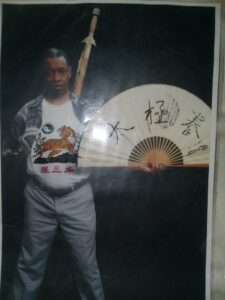
Alan Sims offers a fascinating perspective on martial arts by looking beyond the techniques themselves and toward the possibilities hidden between them. His concept of the “Dao of Movement” challenges the idea that mastery necessarily means becoming increasingly dependent on established forms. Instead, Sims explores what can emerge when knowledge of form becomes a foundation for spontaneous, creative, and adaptable movement.
His approach is particularly intriguing because it crosses traditional boundaries. Taijiquan becomes more than a martial art; movement can become a form of improvisation, self-expression, and exploration. Dance and martial arts, although traditionally associated with different purposes, can meet through rhythm, balance, transition, awareness, and physical creativity.
Sims’ writings emphasize an important distinction: formlessness is not simply random movement. It requires knowledge, control, awareness, and an understanding of how the body can transition from one position or possibility into another. His emphasis on the “in-between” creates an interesting way of thinking about creativity—not as abandoning structure, but as discovering what structure makes possible.
For anyone interested in martial arts, movement, dance, improvisation, or the philosophy of physical expression, Alan Sims’ work presents an invitation to reconsider what it truly means to master movement.
Interview with Alan Sims: The Dao of Movement, Martial Arts & Creative Expression
Your concept of the “Dao of Movement” places considerable importance on what happens between established movements. What first led you to become so interested in the “in-between”?
“The in-between is a concept that one needs to deal with in sparring and or fighting. Initially that was my singular aim; to be able to “hang out” so to speak with all types of martial arts styles, thereby adapting to the movements of others.”
You have described formlessness as being very different from simply moving without structure. How would you explain that distinction to someone encountering your philosophy for the first time?
“The difference between formlessness and simply moving without structure is the same as the difference between talking with someone and just randomly pronouncing words for no reason. Form is like the alphabet and formlessness is like speaking and writing. Although musically I taught myself to play what I couldn’t hear, without ever learning musical scales. But that is something different.”
Your martial arts background includes karate, Ving Tsun Kung Fu, and Taijiquan. How did each of these experiences contribute something different to the way you understand movement today?
“I guess these forms took me in the direction that I’m in by taking me in that direction as a whole by first taking me to Taijiquan. Taijiquan took me further in that direction by my interest in taking almost formless forms (Taijiquan) into just movement itself; beyond fighting, winning or losing.”
At what point does learning a traditional form become a foundation for creativity rather than a limitation on creativity?
“It’s not the form but the individual’s aspiration for self-expression that determines what future steps for development are needed if any. It depends on one’s aim and the continual change of one’s aim.”
Where can we learn more, and why should we?
“I haven’t been teaching Taijiquan or any aspect of it for quite a while, but I could show one how to use Taijiquan to achieve this aim. The reason why one should strive to attain “The Dao of” anything is for excellence in obvious body movement such as sports, dance, Taijiquan. To attain “The Dao Of” anything is to achieve a level of skill that borders that of being supernatural. Although I have achieved to some extent this level, I have actually moved on to other concepts.”
Anything to add here?
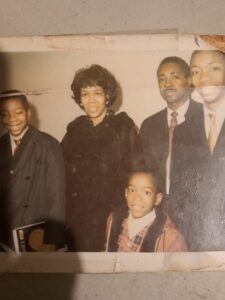
“I would like to thank my late parents Frances and Alfred Sims first and foremost, and also special gratitude to Mercedes Barreto.
James Eaton jr., Lee Moy Shan, Sri Chinmoy (where I first met my original Taijiquan instructor Larry Banks), the late master Jou, Tsung-Hwa, the late Marsha Rosa/Nolan, the late Abdul Musawwir, Bob Arietta, and Sant Rajinder Singh Ji Maharaj of the Science Of Spirituality.”