
INTERVIEW: Grace Jenkins, Actress
Edition Twenty-Six – Week Twenty-Six; Unit 2:
Written by: Jacob West
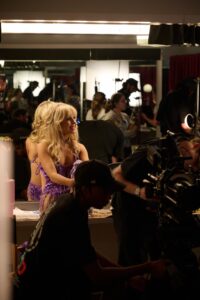
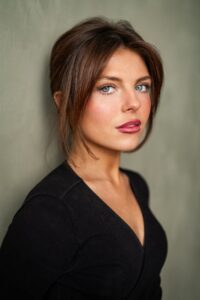
There’s something immediately striking about Grace Jenkins — not just in performance, but in the way she talks about the work. Born and raised in London, she stepped onto the West End stage at a young age, making her professional debut as Annie at the Arts Theatre before joining the original London cast of Grey Gardens and later appearing in 13 at the Ambassadors Theatre. Those early credits established her as a performer with presence, but what feels more interesting now is the direction her career has taken since. Now based in New York, Grace is building a body of work that feels increasingly textured and intentional. Her voice — warm, precise, and unmistakably London — has become one of her most compelling tools, particularly in narration projects like Wicked: The Real Story and the poetic short film The Boy With The Floppy Hair. There’s a quiet authority to the way she handles language, a sense that she understands not just how to deliver text, but how to live inside it.
In conversation, she speaks less about “roles” and more about stories — messy women, flawed people, relationships that feel real rather than polished. She’s drawn to work that dissolves the line between performance and lived experience. It’s that instinct — toward truth, vulnerability, and emotional specificity — that seems to be shaping the next chapter of her career on both sides of the Atlantic.
Your career spans stage, screen, and voice performance. How would you describe your artistic identity as a performer today?
I love being versatile across all creative mediums, and I’m inspired by the actors who do this so successfully. I grew up with a stage/theatre background, and there is nothing more electric than performing to a live audience. However, film is the most magical art form, and I love nothing more than escaping into a beautiful piece of cinema. I’m inspired to tell — and be part of — women-driven stories with fully realized female character arcs. I’m interested in messy characters, people with deep flaws, and reflecting the humanity we see in everyday life.

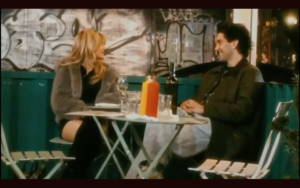
In The Boy With The Floppy Hair, your narration carries much of the emotional weight of the film. How did you approach turning poetry into a lived, cinematic performance?
I came to the script similarly to the way you would approach Shakespeare. Ella Bliss’ poetry was just so gorgeous and visually evocative that I had an instant connection to it. The poem tracks a whirlwind relationship between this young couple who meet in New York. Sectioning the poem and creating beats to help differentiate the memories within the relationship — and identifying what was at the emotional core — was the most important part of my process. When you get such beautiful descriptive language, it’s easy to fall into speaking in a stylized way, so I was very conscious of letting the poem flow naturally in my speech so it could feel conversational.
You’re credited as the narrator in Wicked: The Real Story. What was that experience like, and how does documentary narration differ from character-driven performance?
I tend not to isolate them. For instance, with Wicked: The Real Story, the team was very enthusiastic about my narration having a sense of wonder and magic to help drive the narrative. My narration style was inspired by Glinda the Good Witch and the whimsy she brings to the story of Wicked. As the documentary progressed and more revelations were uncovered, I wanted the audience to receive my voice as another character within the story — like the magical beings who narrate old fairytales.
You began your career in the UK and are now working in New York. How has moving between those creative cultures influenced the kinds of stories you’re interested in telling?
It definitely has, as my knowledge of American playwrights and writers has grown. Growing up in London, I went to the theatre frequently and was well-versed in many playwrights from the UK and Ireland. However, after being in New York, my love for American theatre has blossomed. I am a huge fan of Sam Shepard and deeply influenced by the characters he writes. I’m also enamored by Tracy Letts and the family dynamics he portrays so powerfully. I’ve always been creatively moved by kitchen-sink realism and film that feels so authentic it doesn’t seem like performance at all. What Stephen Graham, Jack Thorne, and Philip Barantini were able to achieve with Netflix’s Adolescence, shooting each episode in one continuous sequence, was one of the most thrilling viewing experiences I’ve had in a long time. I want to be part of something as invigorating as that.
Are there particular artists, performers, or filmmakers who have influenced or inspired your work?
There are many artists who have influenced me — and who I borrow from. Growing up, I was obsessed with Julia Roberts. Watching Pretty Woman for the first time, the charisma and light she brings to the screen felt effortless. There is something so undeniably authentic about her, and in every performance she brings such truth and vulnerability. I will never forget watching Guillermo del Toro’s Pan’s Labyrinth. My dad had been pestering me for weeks to watch it. I finally put it on in my living room, dimmed all the lights, and sat alone in silence. It was a transcendental experience. That film completely changed me. I was blown away by the performances, the imagery, the special effects, and the soundtrack.
Another impactful performance is Jack Nicholson in One Flew Over the Cuckoo’s Nest. I’m not sure how what he did in that film was humanly possible. And a film I return to constantly is Manchester by the Sea, written and directed by Kenneth Lonergan. I am hypnotized by Casey Affleck and Michelle Williams’ performances, and Lonergan’s screenplay is so rooted in truth that it feels as though I’m observing something unfolding outside my own window.
Collaborators often talk about the energy an actor brings into the room. What do you aim to contribute to a rehearsal process or a film set?
I always aim to bring positivity to everything I work on. It’s so important to have good energy around you when creating art so that you can be fully vulnerable and feel safe. I want to approach every project with as much preparation and work ethic as I can bring. It’s crucial to remember how important the arts are and the work we do — while also remembering that it’s a privilege and not something to take too seriously. There are people out there saving lives.
Looking ahead, are there any dream roles, genres, or creative projects you feel especially drawn toward right now?
I would love to be part of something that is primarily female- or female-identifying-written, directed, and produced. I want to tell stories that place women’s experiences and characters at the forefront. A character like Tiffany in Silver Linings Playbook would be incredibly exciting to explore. I love female characters who are not afraid to be messy, wild, and vulnerable.
Grace Jenkins is an artist guided by instinct and intention. Drawn to emotionally complex characters and stories rooted in truth, she approaches each project with clarity and depth. As her work continues to expand across stage, screen, and voice, she is steadily shaping a body of performances that feel thoughtful, textured, and unmistakably her own.