Naomi Orange on Making Punk Theatre in New York
Edition Two – Week Two; Unit 3:
Written by: Jacob West
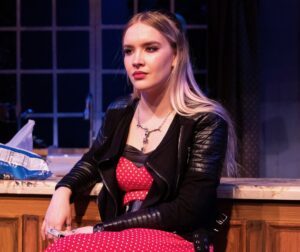 Naomi Orange on Making Punk Theatre in New York
Fruit Fly Theatre Company has developed a distinctive presence in New York’s independent theatre scene. Founded by three Stella Adler graduates, the company describes itself as a punk theatre company focused on creating socially engaged, boundary-pushing work through collaboration, including both new writing and reimaginings of classical texts. Its productions have attracted attention from the theatre community, with the company receiving coverage from publications including American Theatre.
For Naomi Orange, one of the company’s co-founders alongside Valentina Avila and Valentine Marie, that work has meant taking on several roles within the company. Alongside performing in Fruit Fly’s productions as a resident principal actor, she also works as a producer and co-artistic director, helping shape projects from their early development through to performance. Her work with the company so far has included The Wish, La Casa de Bernarda Alba, and Throuples Counseling.
We spoke with Orange about the company’s approach to making theatre, the relationship between producing and performing, and the different demands of the productions she has helped create.
Let’s start with the origins of Fruit Fly. What did you and the other founders hope the company would contribute to New York’s theatre landscape when you started it?
Naomi Orange: We wanted to form a company that was community focused rather than profit focussed. We wanted to create work for other immigrants and queer people, and to make socially conscious work that was financially accessible to audiences. But aside from having a strong set of values, we wanted the company to have a distinct identity. We were toying with the idea of horror for a while before I pitched the idea of punk theatre. Punk ideology aligned nicely with many of the values we already wanted Fruit Fly to have. Not only this, but aesthetically it was an artistic vision I didn’t often see theatre companies exploring. I grew up in a punk family, so it’s a world and style that I’ve been familiar with for most of my life.
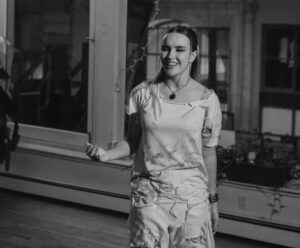 The company describes itself as a punk theatre company. What does that mean in practical terms when you’re actually making a production?
Orange: For starters, our aesthetic vision for each project is usually influenced by punk style and tailored to fit the unique world of each production. But more importantly, punk influences how we actually create the production. The central punk ideology that we always come back to is community. We build collaboration into our process and try to create opportunities for immigrants, women, and queer artists. We like working with local artists, developing new scripts, and keeping our tickets affordable.
You’ve been involved with Fruit Fly both onstage and behind the scenes. What does your role as a co-founder and producer actually involve?
Orange: It varies depending on the production and how many people we bring onto the team but my responsibilities often include things like venue liaison, scheduling, marketing, press outreach, casting, task delegation, ticketing, and communicating with other production staff. Aside from the practical side, I also contribute to the creative vision of each project and make sure it connects back to Fruit Fly’s identity. That can mean working on social media and promotional materials, poster design, costumes, props, and other aesthetic elements.
The Wish was Fruit Fly’s debut production, and you worked on it as a performer, producer, and assistant director. Can you tell us a little about what went into the production from your end?

Orange: I think funnily enough, even now, our debut production is the one I did the most work on. I was so busy with everything behind the scenes that a couple of weeks before the production, I realised I still had a four page monologue to learn!! Assistant directing such an unconventional project was also really rewarding. I worked with the director, Valentina Avila, on choreography, musical choices, and the recurring themes of the piece that we wanted to focus on. I also handled the costume, hair, and makeup design, which is something I really enjoy. From an acting perspective, Claire was a great character to play. It definitely presented its challenges working within such an unconventional structure, often delivering these big walls of text. But her dialogue was so subjective in nature, leaving me a lot of room for interpretation, which is always exciting. I also got to tap into my dance training, doing a lot of movement, which is one of my favourite things to do as a performer.
The production sold out its run and received coverage from a number of publications. What did that response mean to the company at that stage?
Orange: Getting to experience that kind of success with our first production really meant so much to us. I remember how it felt to see people respond so strongly to such a powerful, socially engaged piece, and even come back the next night to see it again. For the last show, I remember we had to add a lot more chairs because we wanted people on the waitlist to be able to see it too. To sell out your first production and get press for it too was really something we didn’t expect so early in the game.
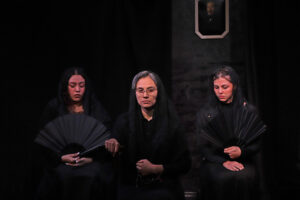
In La Casa de Bernarda Alba, you took on the role of the Narrator. What was it like stepping into that role?
Orange: Something we do as a company is alternate between classics and new work, which is wonderful as a performer. There was lots of poetic language, which is right up my alley, and plenty of long monologues that really put my voice and speech training to work. I certainly had to be careful about protecting my voice throughout the run. There was also a lot of quiet observation and opinion forming involved in this role, as I spent many of the scenes watching from the stage. Learning to be engaged and responding without speaking is always a great skill to practice as an actor.
 Fruit Fly’s next production, Throuples Counseling, moved into dark comedy. What was different about working on this kind of material?
Orange: Production wise, the styling was very different, transitioning from these very artistic pieces to something more sitcom-esque. Organising the cast and scheduling rehearsals was also much easier, as for once we were working with a smaller cast. It was also our first time working directly with the writer on the show, which was great. Throuples Counseling was our easiest show to sell out yet, as I think it was a work that was a lot more accessible to people who don’t really indulge in theatre. Not everyone wants to go see a classical Spanish tragedy, but everyone loves to laugh. From an acting standpoint, working on a comedy was also very different, especially as the main antagonist within a comedy. I had to bring a real seriousness to the play and create a lot of the conflict and stakes within it. I will say, it certainly was a challenge seeing the other characters doing scenes that would have me roaring with laughter and then having to come in for my deeply depressing scenes.
Looking across three very different productions, what connects them for you?
Orange: I think at the heart of all these productions are the punk values that we look for. That’s one of our favourite things about this work: those ideas can exist within almost any style. The Wish is a confrontational, experimentally structured piece about Roe v. Wade. La Casa de Bernarda Alba deals with the oppression of women while also engaging with Hispanic culture. Throuples Counseling is a modern exploration of queer life and relationships.These shows are all socially conscious and provocative in their own ways. They give a voice to groups and perspectives that are often underrepresented, which is something that we always aim to as a company.
Your work with Fruit Fly has also put you in a position where the company’s success and your own work as a performer are closely connected. How do you think about that relationship?
Orange: The two definitely help each other. I think people are often interested in an actor who is also pursuing their own creative vision and making their own work through a company. My individual acting work has also led to opportunities to talk about Fruit Fly. For example, I received quite a bit of press for my involvement in Snazzy, and a lot of the time, those conversations would also lead to questions about Fruit Fly and the work we were doing there.
What do you think Fruit Fly has established so far and what are you working toward next?
Orange: As a company, we’ve been lucky enough (and worked hard enough) to enjoy a lot of success. Our productions have regularly sold out, and we’ve received great reviews. We’ve presented shows that were financially accessible and have employed a lot of immigrant, queer, and female artists across our projects. We’ve received press from outlets like BroadwayWorld, as well as international press, including The Post, the newspaper I grew up reading in New Zealand. We were also interviewed by American Theatre, which was particularly exciting for us, and many other outlets. It’s amazing to see how interested people are in the work we’re doing. So far, we’ve involved more than 50 artists across our productions, had shows extended, and brought hundreds of people into our audiences. We’ve also been able to collaborate with venues with real history, like the Producers’ Club. For us, the goal now is to keep growing while continuing to put our profits back into the community. We have The Last Days of Judas Iscariot coming this winter, and a full season lined up for 2027, so there’s a lot we’re excited about.