Dr. Joanne Magro “The Power of the Stiletto.” News Column (017)
Edition Seventeen- Week Seventeen; News Column:
Written by: Dr. Joanne Magro
7-OH: THE OPIOID-HIDING IN PLAIN SIGHT- By Dr. Joanne Magro
A physician’s warning about concentrated 7-hydroxymitragynine, addiction, youth exposure and an emerging public health threat.
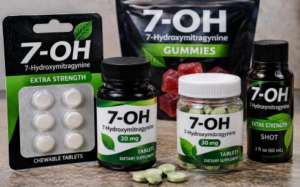
A Growing Public Health Threat on America’s Store Shelves
Across the United States, a powerful opioid-like substance is being sold in gas stations, smoke shops, convenience stores, and online marketplaces. It is often displayed alongside energy drinks, dietary supplements, and other seemingly ordinary consumer products. Its name is 7-hydroxymitragynine, commonly known as 7-OH. Despite its accessibility and sometimes misleading marketing, 7-OH is not an innocuous herbal supplement. It acts on opioid receptors and carries risks of dependence, addiction, respiratory depression and overdose. Retail availability should never be mistaken for proof of safety.
What Exactly Is 7-OH?
7-Hydroxymitragynine is an alkaloid associated with the kratom tree, Mitragyna speciosa, native to Southeast Asia. Natural kratom leaves contain mostly mitragynine and comparatively little 7-OH. Commercial concentrated 7-OH preparations can be substantially different from traditional kratom leaf. 7-OH activates mu-opioid receptors involved in the effects of morphine and other opioids. Laboratory potency comparisons do not directly predict human overdose risk.
7-OH: THE OPIOID HIDING IN PLAIN SIGHT | Dr. Joanne Magro 1
What Is Actually Inside These Products?
Products are marketed as chewable tablets, capsules, gummies, shots, liquids and extracts. Formulations can contain concentrated 7-OH, residual mitragynine, other alkaloids, flavorings and fillers. Label accuracy, product purity and quality controls may vary. Independent testing is important because consumers cannot safely infer the contents or strength from packaging alone.
How Are People Using 7-OH?
Reported reasons include pain relief, relaxation, euphoria and attempts to self-manage opioid withdrawal. Others use it recreationally or because it appears easier to obtain than prescription opioids. 7-OH products are not FDA-approved treatments for pain, anxiety or opioid use disorder. Marketing claims of “natural” or “legal” do not establish clinical safety.
The Pharmacology: Why 7-OH Is Dangerous
As an opioid-receptor-active compound, 7-OH may cause sedation, nausea, constipation, impaired alertness and respiratory depression. Combining it with alcohol, benzodiazepines, prescription opioids or other sedatives increases concern. Severe toxicity can be life-threatening, and the absence of reliable labeling makes exposure harder to predict.
Addiction, Dependence and Withdrawal
Repeated exposure can produce tolerance and physical dependence. Withdrawal may involve anxiety, insomnia, sweating, diarrhea, nausea, muscle aches, irritability and cravings. Dependence is physiological adaptation; addiction refers to continued compulsive use despite harm. Individuals trying to avoid other opioids can still develop dependence on concentrated 7-OH.
Adolescents and Young Adults: A Particularly Vulnerable Population
Adolescence and early adulthood involve ongoing development of decision-making and reward-processing systems. Attractive gummies, flavors and colorful packaging can obscure the seriousness of opioid activity. Easy retail access and limited awareness create an especially important prevention challenge.
The Influence of Social Media and Peer Culture
Social-media promotion and peer discussion may emphasize euphoria, relaxation or supposed benefits while overlooking overdose and dependence. Plant-derived does not mean harmless: morphine, too, comes from a plant. Parents and educators should discuss these distinctions clearly and without stigma.
Early Exposure and the Risk of Addiction
Curiosity, peer influence or attempts to manage distress may lead to experimentation. Repeated use can become difficult to control. Changes in sleep, academic performance, spending or behavior can justify a supportive conversation, although none of these signs alone proves substance use.
7-OH: THE OPIOID HIDING IN PLAIN SIGHT | Dr. Joanne Magro 2
Protecting Young People Through Education and Prevention
Prevention requires clear education, truthful labeling, safeguards against youth-directed marketing, age-appropriate retail controls and early access to treatment. Young people should know that mixing sedating substances can be dangerous and that over-the-counter availability is not a medical endorsement.
Recognizing a Potential 7-OH Overdose
Warning signs include unresponsiveness, slow or absent breathing, abnormal gurgling, severe sedation and blue or gray lips. Call 911 immediately. Administer naloxone if available and follow dispatcher instructions for rescue breathing or CPR. Naloxone may reverse opioid-mediated respiratory depression, but additional doses and emergency care may be needed.
Poison Control Reports and Emerging Clinical Concerns
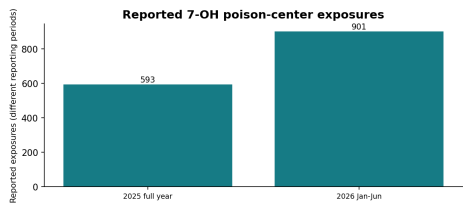
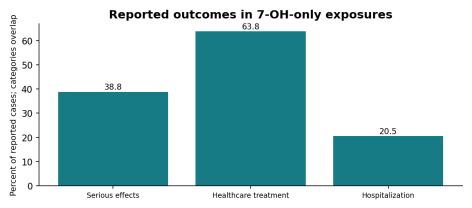
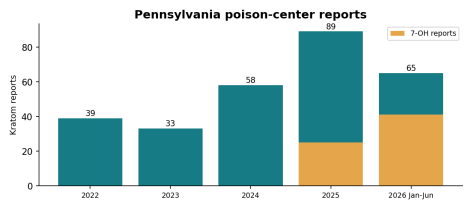
Poison-center reports have raised concerns about concentrated 7-OH exposures, including serious symptoms and healthcare utilization. Surveillance captures only reported exposures, not all users or all overdoses. Some cases involve multiple substances. Standard urine drug screens may not identify 7-OH, so clinicians should rely on clinical assessment.
7-OH: THE OPIOID HIDING IN PLAIN SIGHT | Dr. Joanne Magro 3
Surveillance: Three Statistical Views
7-OH and America’s Broader Opioid Epidemic
Concentrated 7-OH products add a distinct challenge to an already serious opioid crisis: potent opioid activity in ordinary retail environments. Evidence does not justify equating its population-level toll with fentanyl, but early detection and prevention remain essential.
The Emergency Medicine Perspective
For emergency physicians, clinical presentation matters more than packaging. Patients with depressed respirations or altered mental status need prompt airway and breathing assessment, evaluation for co-ingestants, and treatment of suspected opioid toxicity. Emergency departments also provide opportunities for overdose education, naloxone access, nonjudgmental care and addiction-treatment referral.
7-OH: THE OPIOID HIDING IN PLAIN SIGHT | Dr. Joanne Magro 4
The Need for Regulatory Oversight and Public Awareness
Public health priorities include accurate labeling, independent testing, restrictions on misleading claims, protections for young people, improved toxicology surveillance and research into real-world harms. Federal and state regulatory approaches vary, and the evidence base is still developing.
Conclusion: A Warning We Cannot Afford to Ignore
7-OH is not simply a harmless herbal product. Concentrated preparations can produce dependence, withdrawal and serious opioid toxicity. Public education, rigorous science, responsible oversight and access to treatment are needed now. The fact that a substance can be purchased at a gas station does not make it safe. The fact that it comes from a plant does not make it harmless. And the fact that it is sold without a prescription does not make it incapable of causing addiction or taking a human life.

Selected Sources and Editorial Notes
FDA, “Preventing the Next Wave of the Opioid Epidemic: What You Need to Know About 7-OH” (fda.gov/media/187900/download); Center for Forensic Science Research and Education, “Evaluation of Commercially Available Smoke Shop Products Marketed as 7-Hydroxy Mitragynine” (2025); National Institute on Drug Abuse, kratom research; Kruegel et al., Journal of the American Chemical Society (2016); Váradi et al., Journal of Medicinal Chemistry (2016).
Graph figures reproduce numbers presented in the earlier conversation as attributed to America’s Poison Centers and Pennsylvania Department of Health; the original underlying datasets were not independently retrieved for this PDF. Treat them as provisional until checked against the primary reports. This edition reconstructs the earlier article; it is not a verbatim recovery of a saved original.
7-OH: THE OPIOID HIDING IN PLAIN SIGHT | Dr. Joanne Magro 5
“The Doctor Joanne Magro Foundation for Physician Health and Wellness”/ jmagromd@gmail.com and Peer Support Specialist for Addiction Recovery and Support Community Outreach/ jmagromd@gmail.com.
—————————
What topics would you like to read next by authorship of Dr. Joanne Magro in the upcoming edition of her column? Leave your comments below!